The Accidental Experiment
Updated August 2026: subscriber counts, algorithm data, and what the newsletter actually built. The original numbers from 2025 are struck through where they've been superseded.
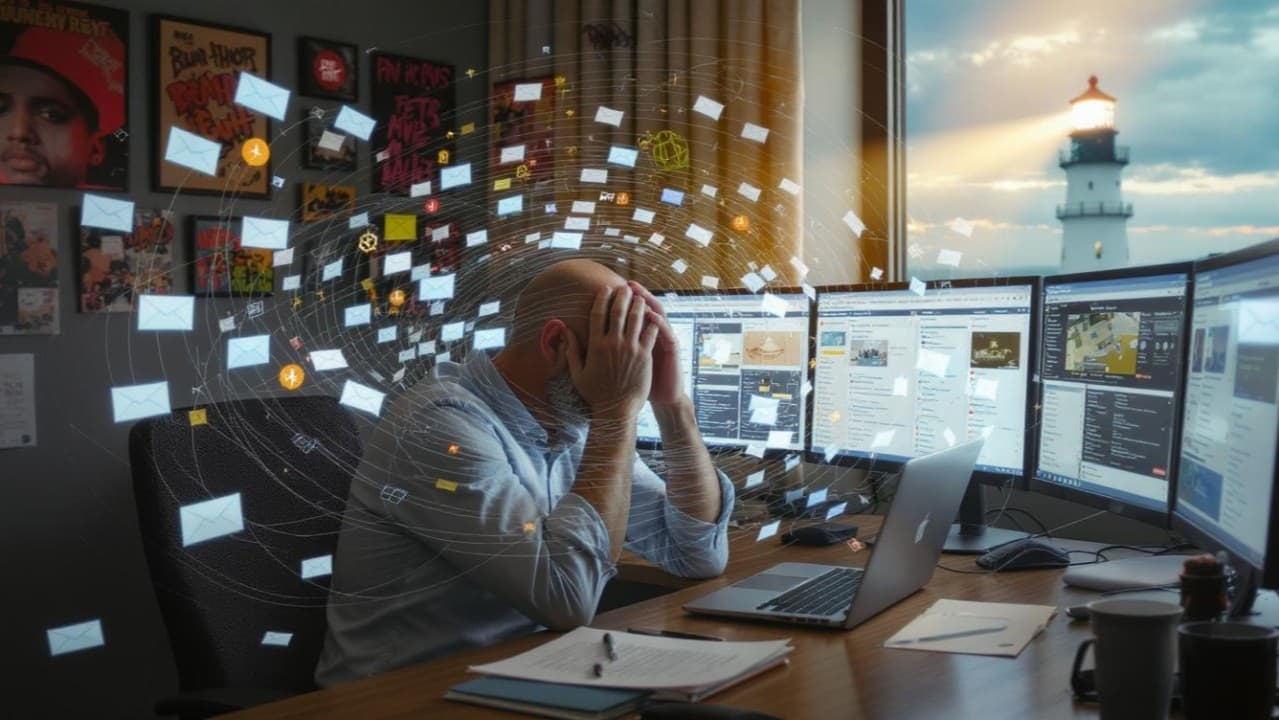
I was a digital hoarder drowning in my own curiosity. Bookmarks breeding like rabbits across seventeen different apps, insights scattered like puzzle pieces that never quite formed a complete picture. My research for various projects had become unmanageable. I couldn't find what I'd saved, couldn't cluster related ideas, and was increasingly failing to develop the cross-industry insights that drive real innovation.
Sound familiar? If you're working in healthcare innovation, you know the feeling. We're swimming in a sea of information from technology trends, regulatory changes, clinical studies, and business implications. The challenge isn't finding content, it's transforming that chaos into actionable intelligence.
The honest experiment begins
Instead of continuing to study and organise, and fail, I decided to build a forcing function. What better way to structure my material than committing to write a weekly piece of inspiration? Publicly. A newsletter. On LinkedIn. With a deadline that couldn't be ignored.
My hypothesis was simple: use this newsletter as a laboratory for weekly experiments in AI integration and knowledge synthesis. I wanted to learn how AI could help me read faster, analyse trends more effectively, automate processes, improve workshops and manage projects more efficiently. The secondary goal (and I'll be honest) was generating some business leads along the way.
But the deeper motivation was transforming my frustration with healthcare's glacial pace of innovation. Instead of bashing the Luddites and lamenting regulatory roadblocks, I wanted to build a modest lighthouse. Something that could inspire others to innovate, offering positive alternatives rather than just critique.
The laboratory results — 14 months in
A little over a year later Fourteen months later, the experiment has yielded insights I did not predict. The newsletter grew from 200 to 700+ 968 subscribers. That is steady, organic growth that secretly disappointed me — I'd hoped for more. But that disappointment taught me something valuable about authentic growth versus marketing optimisation.
The subscriber number is the least interesting metric. Here is the one that surprised me: article views have held steady between 420 and 462 for twelve consecutive weeks (as of August 2026), while feed impressions swung between 842 and 9,146 in the same period. The delivery channel (people who actually read the article) and the amplification channel (how many people LinkedIn shows it to) have completely decoupled. I track this weekly in an analytics task that has run every Friday since January 2026 — 30 consecutive weeks of data, logged with the same method each time.
That decoupling is the most useful thing the newsletter has taught me about algorithms. In May 2026, LinkedIn replaced its entire ranking system with 360Brew, a ~150-billion-parameter AI foundation model that reads content semantically rather than counting engagement velocity. The same week I published a high-effort edition on wearables (Whoop / Oura Ring), my profile post impressions collapsed 77% — from 3,649 to 842. But article views dropped only 4%. Direct delivery to existing subscribers still worked. What collapsed was the feed amplification to non-subscribers.
I now track both numbers separately every week. The pattern has held for three months: reach swings 40-60% post-to-post, views hold. If I had only tracked impressions — the metric LinkedIn pushes hardest — I would have concluded the newsletter was dying and pivoted. It wasn't. The algorithm changed; the audience didn't.
What the newsletter actually built
This is the part I couldn't have predicted. The weekly discipline of researching and synthesising across healthcare, technology, and business didn't just produce content. It produced infrastructure.
An events database that refused to stay small. What started as "I need a list of longevity conferences for the newsletter" is now longevents.hyperadvancer.com, a living database of 496 events, 4,148 speakers, 1,896 sponsors, and 3,159 organisations. It runs automated weekly quality checks. It has its own SEO pipeline: Google Search Console audits, Bing Webmaster Tools tracking, SERP position monitoring across 50 keywords, and AI-Overview citation checks — all running every Friday, all built because the newsletter needed the data and I refused to maintain it by hand.
A personal operating system. My Obsidian vault (BartOS) now runs 76 skills across strategy, research, content, events, prototyping, client communications, and Obsidian workflows. A monthly audit script counts which skills were actually invoked across 90 days of session transcripts; skills that earn their keep stay, dead weight gets archived. The June audit caught a skill with write access to a production database that had been left un-gated. Found by the audit, fixed the same day.
A suite of N=1 tools. The newsletter's research loop spawned tools that each serve an audience of one (sometimes a few): a partnership roulette that matches companies across 100+ profiled organisations, a pitch competition platform that processed 70+ applications, a documentation portal that replaced a 200-page manual for a healthcare client. Each one built in hours, not months. I wrote about these in a separate piece, but the point here is that none of them would exist without the weekly forcing function.
The newsletter did not become a business. It became a system that builds things.
What the data says about overthinking
The LinkedIn algorithm remains mysteriously unpredictable. The LinkedIn algorithm is predictable in one specific way: the editions I laboured over, convinced they were groundbreaking, often fell flat. Meanwhile, pieces I wrote in record time during creative flow gathered more reactions. the data from 13 tracked editions shows no correlation between effort and reach. Format B (curated, structured) and Format A (single-essay) produce indistinguishable impression ranges. First-person-scene openers appear in 9 of 13 tracked editions and correlate weakly with engagement. The one variable that moved the needle was the 2026 algorithm overhaul, not anything I did in the writing.
There's a lesson about overthinking versus authentic expression buried in that data, but it's not the lesson I expected. The lesson is: stop optimising for the algorithm and start building infrastructure around the content. The algorithm will change again. The events database, the SEO pipeline, the N=1 tools — those compound regardless of what LinkedIn's ranking model does next.
I switched from Evernote to Obsidian early in the process. Good data architecture became foundational for improving my work. The weekly discipline forced me to develop systems for capturing, connecting, and synthesising information across healthcare, technology, and business domains. Exploring hundreds of AI tools and models Testing over 200 AI tools and models by applying them to concrete, real-world tasks was an intensive yet essential process to genuinely grasp their potential impact and practical value.
Why graffiti art frames every edition
Each newsletter features graffiti art imagery, and there's a deliberate reason beyond aesthetics. Hip hop culture represents the ultimate example of combinatorial creativity: sampling across genres, manipulating speed and loops, scratching to alter how music is played, weaving together fashion, behaviour, and visual art into a coherent whole. I can't think of another movement that combines so many disparate influences while maintaining such strong cultural identity.
Growing up with Run DMC and LL Cool J, I was completely hooked after watching a Dutch documentary in late 1986 about hip hop's origins. That culture taught me something profound about innovation: true breakthroughs come from unexpected combinations, not isolated genius. The graffiti imagery reminds me, and hopefully my readers, that healthcare innovation needs that same combinatorial mindset — blending insights from technology, policy, clinical practice, and human behaviour into something greater than the sum of its parts.
The real discovery
What started as a personal productivity hack hasn't yet become a business strategy, and I'm intentionally keeping it that way. The tension between genuine knowledge sharing and business development is real, but maintaining authenticity remains my priority. The newsletter serves as proof that you can build meaningful professional relationships through value-first content without sacrificing credibility.
The most unexpected outcome? The creative process itself became an innovation forcing function. The creative process became an infrastructure-building loop. Weekly deadlines combined with systematic curation sparked cross-industry pattern recognition I never anticipated. But the deeper discovery was that the byproducts of the newsletter — the databases, the tools, the analytics systems — outgrew the newsletter itself. Constraints, it turns out, don't limit creativity — they channel it into building things that last longer than a Friday post.
Your own forcing function experiment
Here's my challenge to you: what's your equivalent of drowning in curiosity? What forcing function could transform your passive consumption into active creation? Whether it's a newsletter, podcast, or internal knowledge-sharing initiative, the key is public commitment with regular deadlines.
But here is the part I'd add 14 months in: don't just commit to the content. Commit to building the infrastructure the content needs. The newsletter was the forcing function. The events database, the SEO pipeline, the N=1 tools — those are what the forcing function built. They will outlast every algorithm change, every platform redesign, every impression swing.
The healthcare innovation ecosystem needs more positive provocateurs — people willing to build lighthouses rather than just complain about the darkness. Your unique perspective, systematically shared, could be the catalyst someone else needs to take action.
What experiment will you commit to this week?
💥 May this inspire you to build your own forcing function — and to count what it builds, not just what it publishes.