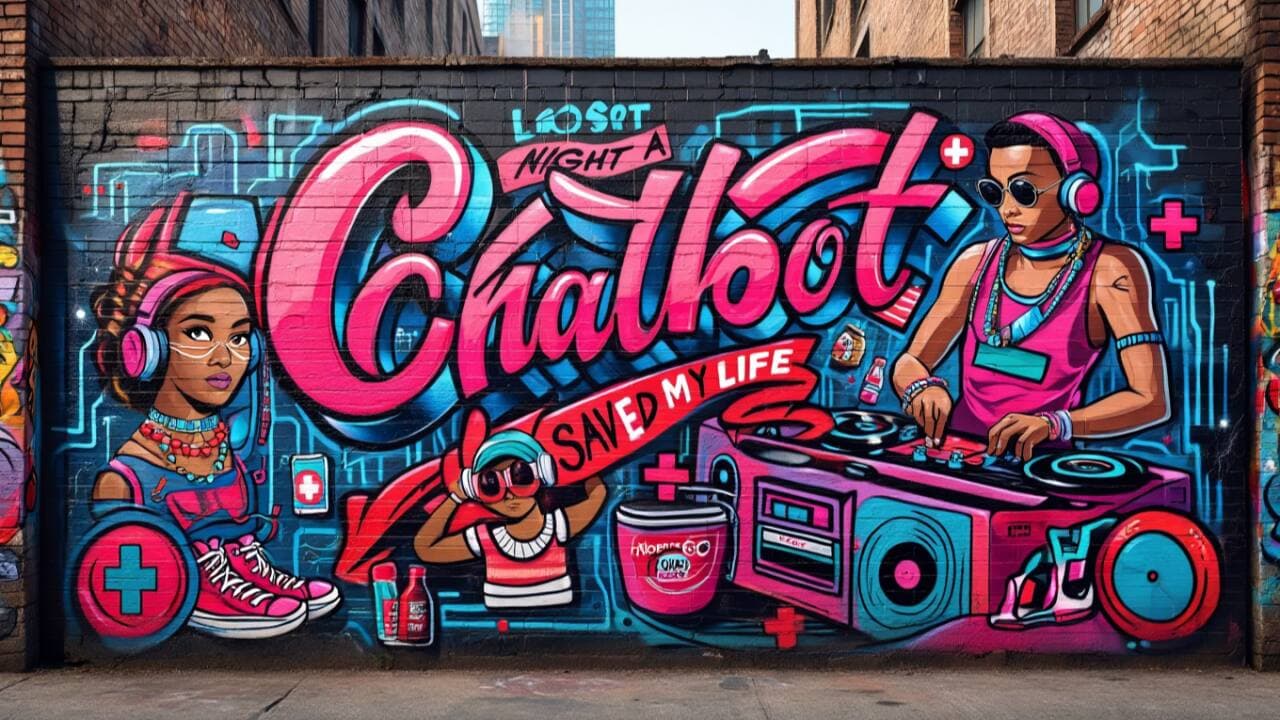
Last night a chatbot saved my life
On Monday 28 April 2025 a friend of mine, who happens to share my first name, was on holiday in Spain when the power went out. Not a blown fuse: a large outage. The cell towers went down with it. No internet, no mobile network, no way to look anything up.
He is a technical person, and he had done something most people have not: he had installed a language model on his iPhone 16 that runs entirely on the device. No connection needed. So with every online service out of reach, he still had something to ask.
He first asked it the obvious things: how to fix the electricity, and how to find his way. Then, out of curiosity, he started testing it on health. Where would the nearest hospital be? What do you do with this symptom, or that one? There was no medical emergency. Nobody was hurt. It was a test. His conclusion afterwards was sober and has stayed with me: this could possibly be a life saver.
Indeep sang it in 1982 about a DJ. The chatbot version is less romantic and more practical: the day the network disappears, the only medical knowledge you still have access to is whatever is already in your pocket.
Who is actually asking chatbots about their health?
When I first wrote this piece in mid-2025, the shift from "Dr Google" to "Dr GPT" was mostly a prediction. It is now measured. I went looking for the most recent figures from sources I trust, for three regions. This is what exists as of September 2026.
| Region | What was measured | Result | Source |
|---|---|---|---|
| United States | Adults who ever use AI chatbots for at least one of eight health and medical reasons | 34%; 44% among ages 18-29, 17% among 65+ | Pew Research Center, surveyed June 2026, 3,488 adults |
| United States | Adults who turned to AI for health information or advice in the past year | 32%; 29% for physical health, 16% for mental health | KFF, surveyed February-March 2026, 1,343 adults |
| Germany | People aged 16+ who have asked a chatbot about symptoms or general health questions | 45%; 10% do so often, 17% sometimes, 18% rarely | Bitkom Research, phone survey, autumn 2025, 1,145 people |
| United Kingdom | Adults who used an AI chatbot for health advice instead of contacting a GP or another NHS service | 15% | King's College London with King's Health Partners and Responsible AI UK, published May 2026 |
| Asia | No comparable general-population survey of actual use that I could find | n/a | See below |
| 30 countries | Adults who say they would be likely to accept AI-generated health information | 58.3% overall; above 75% in China, India, Pakistan and Indonesia; below 50% in Japan, Belgium, France, the UK, Italy, Sweden and five others | CUNY SPH-led survey of 31,000 adults, August-September 2025, published in Nature Health in 2026 |
A warning before anyone turns this into a league table: these surveys do not ask the same question. "Ever used" is not "used in the past year", and "instead of a GP" is a much narrower thing than either. Bitkom is a German digital industry association, its survey was done by phone, and its 45% includes people who do this rarely. So the table does not show that Germans consult chatbots more than Americans. It shows that in every country where someone bothered to ask, somewhere between one in seven and almost one in two adults already does this.
Three things stand out to me.
The United States measures this obsessively; the rest of the world barely does. Two high-quality American surveys within four months of each other, landing on almost the same number. For Europe I found national snapshots with different questions. For Asia I found studies of medical students, of doctors, and of how well the models score on licensing exams, but no solid population figure for how many people actually ask a chatbot about their health.
The willingness runs the opposite way to the measuring. In the one survey that put the same question to 30 countries, the places most open to AI-generated health information are China, India, Pakistan and Indonesia. The sceptics are mostly high-income countries, my own Belgium among them.
Asia is not one thing. Japan sits with the European sceptics, not with its neighbours. Anyone building a "health chatbot for Asia" on the back of the Chinese and Indian numbers is going to be surprised in Tokyo.
Read together, this suggests that the appetite for a chatbot doctor has less to do with how good the technology is and more to do with how hard it is to reach a human one. The 25-year-old in the Pew data and the respondent in Indonesia have something in common: a conversation with a model is available now, and the alternative is not.
Why conversation beats search
Health questions lend themselves to dialogue rather than keywords. When someone asks, "I've had this recurring headache for three weeks, it's worse in the morning, and I'm also feeling unusually tired; what could this mean?", they want interpretation, not a list of websites. In the Pew survey the reasons people give most often include exactly that: getting information quickly (28% of all adults), working out what is causing symptoms (25%), and understanding a diagnosis their doctor gave them (22%). Stories keep emerging of a chatbot flagging something the user had not considered.
The same survey carries the counterweight: of the people who use chatbots for health, 47% call the information extremely or very helpful and 48% only somewhat helpful. In the UK study, one in five users said they had decided against seeking professional advice because of something a chatbot told them. That number should worry everyone who builds these things.
The part nobody is designing for: no network
Almost every vision of AI in healthcare, including the ones I wrote in the first version of this post, assumes a connection. The avatar on your phone that talks to your GP. The guardian angel watching your wearable data. All of it quietly depends on a network and a data centre being there.
My friend's day in Spain is the counter-example. A model small enough to run on a recent phone, with no connection at all, was still answering questions when nothing else was. That is a design brief:
- Offline is a feature, not a fallback. Blackouts, floods, festivals, mountains, ferries, and every rural area with patchy coverage. The moments you most need medical information overlap heavily with the moments the network fails.
- Know what it cannot do. An offline model has no map and no live data. Ask it where the nearest hospital is and it will answer with confidence and may be wrong. Navigation is a job for offline maps; first-aid knowledge and triage questions are where a local model earns its place. A well-designed health assistant should say so itself.
- Privacy comes free. A model that never leaves the phone never sends your symptoms anywhere. For the sceptical countries in the table above, that may matter more than accuracy benchmarks.
There was no emergency that day, and I am not going to pretend a chatbot saved anyone's life. But I understand why a technical, level-headed person walked away from that blackout convinced it one day could.
For innovators and healthcare leaders, the question has moved on from whether people will ask a machine about their health. A third of American adults and nearly half of Germans already do. The open questions are who is measuring it where nobody is looking, and what your service does on the day the network goes dark.
💥 May this inspire you to advance healthcare beyond its current state of excellence.