The patients who stopped asking permission
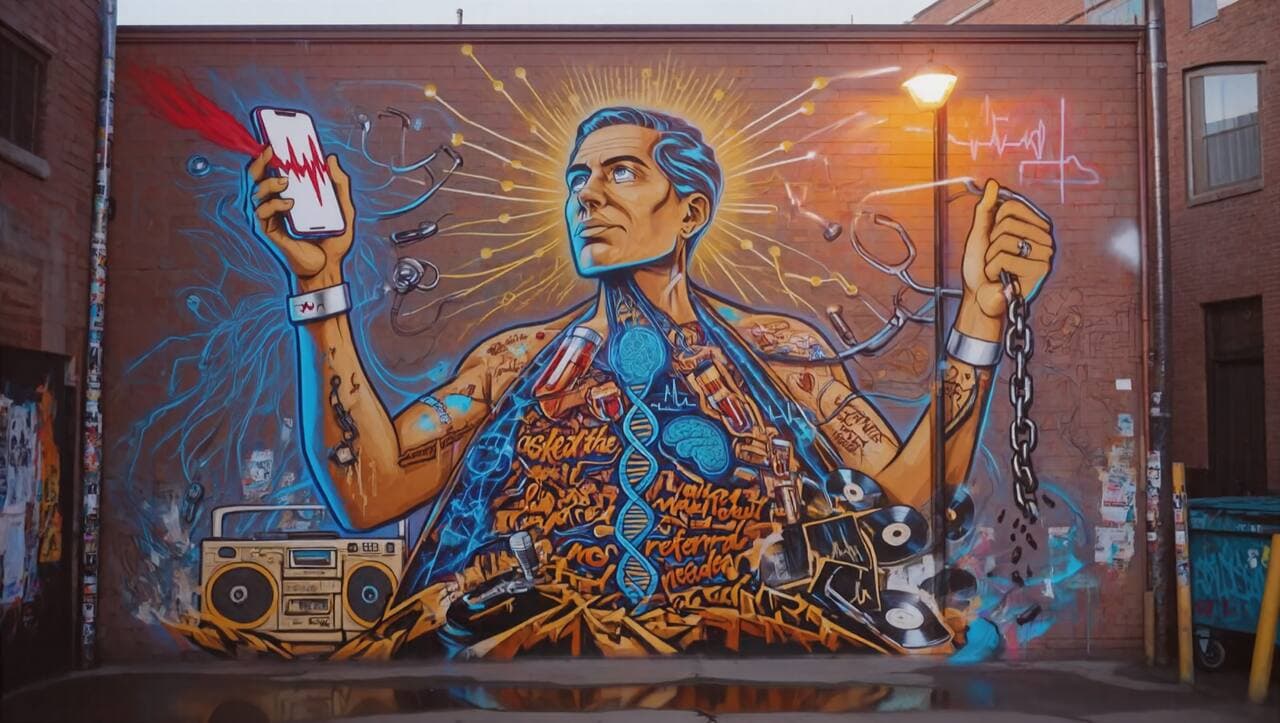
What do Sid Sijbrandij, Steve Brown, Pratik Desai, Arun Verma and Marc van der Chijs have in common?
Sid co-founded GitLab, ran out of standard treatments for osteosarcoma, hired a geneticist, collected 25 terabytes of his own tumour data, and used AI to find a protein anomaly. Immune cells engineered against that anomaly put him in remission. He now publishes the data on osteosarc.com so the next patient starts further along.
Steve was told his cancer symptoms were stress and gas. He built an AI agent called Haley on the same data three doctors had already seen, and within minutes Haley flagged the blood-cancer markers they had missed.
Pratik vibe-coded a workflow during his mother's stage-4 treatment. The tool caught three life-threatening errors the inpatient team did not. She got 76 days, 67 of them inpatient. He says none of them felt like the system was tracking her actual goals.
Arun walked into a Prenuvo scan out of startup curiosity and walked out with a Grade-2 Glioma. He raised $4M to build the tool he wished he had had before the scan.
Marc van der Chijs, a tech and AI investor without a traditional medical or academic biology background, co-founded Helixion Therapeutics in Vancouver and reports that he and his non-academic technical partner Sean Clark built "Elyra," an AI model that rapidly generates personalized cancer-vaccine candidate lists, in roughly three months.
None of them waited for the system. All of them arrived at their diagnosis, their second opinion, or their treatment before the system did.
The self-navigator is no longer the exception. She has infrastructure.
Last week Gallup reported that one in four Americans now use AI for health information. Most to supplement a visit. Some in place of one. Two days later, Perplexity Health launched with a biomarker partner (Function Health), a fitness coach and a nutrition planner. That closes a three-month stretch where ChatGPT Health, Copilot Health, Amazon Health and now Perplexity Health have all gone live. The background figure: 61% of Americans say they worry "a great deal" about the cost and availability of their healthcare. The system is simultaneously the first domestic concern and the thing people are learning to go around.
Three versions of the next decade
The optimistic version. The GP's office becomes a triage and interpretation layer. The AI does detection ; the clinician does the conversation. Patients arrive informed rather than uninformed. Outcomes improve. Clinical capacity stays available for the cases that actually need it, because the healthy cohort has self-triaged.
The dystopian version. Clinicians become prescription machines. Patients present pre-diagnosed, arguing against the doctor on behalf of the algorithm. Diagnostic instinct atrophies on both sides of the desk. The cases that do not fit the pattern (rare diseases, atypical presentations, the drug-interaction you only see after twenty years in practice) get missed more often, not less, because no one in the room is still looking.
The base case, which is what we will actually get. A two-tier system stratified by agency, not income. A $75,000-a-year Healthspanners membership is the visible tip. The invisible part is that even a Medicaid patient with a $20 wearable subscription starts outperforming matched peers on every outcome that gets measured. The best clinicians quietly follow the self-navigators into concierge and longevity practice (see the $9.3M Ultralight raised last week for exactly this), thinning capacity for the passive majority.
Which scenario prevails depends on one unsettled question: who owns the interpretation layer?
What clinicians are actually losing
The unbundling isn't "the patient knows more than the doctor." That was already true in the Google era, and the profession survived it.
The unbundling is who initiates the next step. For a century the patient went to the doctor, who decided what happened next. Now the patient goes to the AI, which decides what happens, and the doctor is the last-mile actuator of a plan the patient and the algorithm have already agreed on.
That is a different job. It is, possibly, a better-paid job. It is not the job anyone trained for.
Cultural tell from earlier this month: Mamata Banerjee, Chief Minister of West Bengal, was photographed wearing Whoop, Apple Watch and an Oura ring simultaneously. When a 70-year-old head of government runs a triple-wearable stack, the authority relationship has already flipped in the minds of the people clinicians serve. The clinicians are usually the last to notice.
The forecast, layered
By 2028, the first medical graduating class trained entirely post-GPT-5 enters practice. Their default assumption: the patient arrives with data.
By 2030, the first MD-PhD programme makes "patient-as-co-investigator" a required rotation.
By 2033, a licensing body somewhere strips the referral gate on primary care altogether, because more than 60% of visits are already self-initiated and the gate is friction without function.
The self-navigator economy isn't a niche. It's the new infrastructure. The clinician isn't being replaced. The clinician is being re-intermediated.
If you work in that profession, the next move isn't to resist the unbundling. It's to decide which part of the job you want to keep owning before the default settles without you.
💥 May this inspire you to notice who is initiating the next step in your own care, and whether that answer has changed in the last 18 months.