The hire your hospital would never make
Picture the last interview panel you sat on. Four people, a printed CV, a competency grid with weighted scores. The candidate who wins is the one who never trips a single box: clean career line, knows the regulations cold, gives measured answers, makes nobody in the room nervous. You shake hands, you tick the form, you make the safe choice. And that, quietly, is the problem.
For thirty years the safe choice was the right one. Healthcare ran on stability, and the job was to keep a complex, regulated machine running without dropping anyone. The people who did that best were careful by design: the compliance lead who knows every rule, the controller who reconciles a thousand internal policies with a thousand external ones. I spent twenty-five years running an elderly-care facility, so I know exactly what those people are worth. In peacetime they are everything.
We are not in peacetime anymore.
Most healthcare organisations are dying of the people they hired most carefully.
The market already switched to wartime
Eric Larsen, a veteran healthcare strategist who has advised industry CEOs for decades, put it plainly on a recent KFF podcast: this is "incumbents versus insurgents," a new generation of startups that are "tech native, agentic and AI native" and moving faster than the institutions can follow. He counts roughly 20 Silicon Valley startups with fewer than 50 employees and more than $250 million in annual recurring revenue each (KFF, 2026). That is the leverage you are now up against.
Larsen's real question is the one that belongs on every health-system board agenda: can an incumbent reshape its workforce faster than an insurgent can displace it? Not its tech stack. Its people.
The customer changed underneath them too. The global wellness economy hit $6.8 trillion in 2024 and is forecast to reach $9.8 trillion by 2029 (Global Wellness Institute). People now expect high-touch, consumer-grade health services, and they buy them from fitness brands, longevity clinics and app makers who shipped a feature this morning, not from a provider working through its change-advisory board.
And the incumbents can feel it. In a 2026 survey at the Asembia summit, 69% of healthcare and life-sciences executives called AI their top priority, yet only 8.3% had it in production, against more than 90% in professional services (AJMC, 2026). The will is there; the execution isn't. One speaker had a name for where these projects stall: pilot purgatory.
That speed gap is the war. And you don't win a war with the org chart you built to avoid one.
What a wartime hire actually looks like
Ben Horowitz drew this line years ago for founders: the peacetime CEO grows an existing advantage, the wartime CEO fights for survival when a single wrong move can end the company (a16z). Healthcare has spent a decade hiring peacetime operators into a wartime market. Pilot purgatory is what that looks like from the inside: careful people carefully managing a fight that punishes caution.
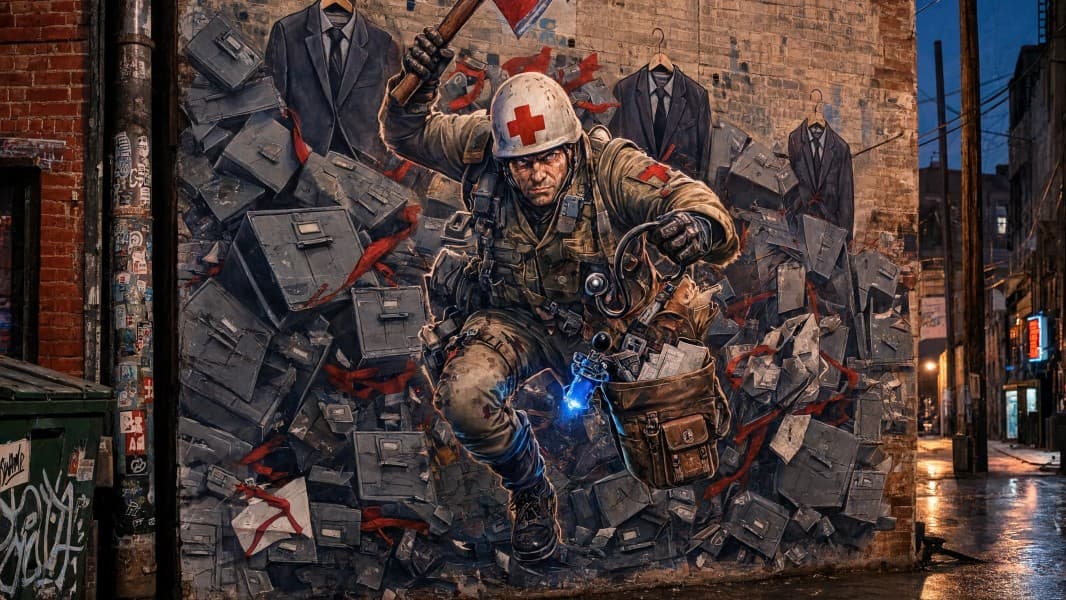
The wartime hire is a different animal. Think of the firefighter who walks into the building everyone else is leaving and makes three irreversible calls in ninety seconds on incomplete information. Or the guerrilla operator who routes around an obstacle instead of filing a request to remove it. These people are inventive under pressure and allergic to ceremony. They will take a shortcut, ship the rough version, and ask permission afterwards, if they ask at all.
Here is the uncomfortable part. Every trait that makes them valuable in a war is one your recruitment funnel is built to screen out. They have gaps in the CV because they were busy building. They bristle at process, because process is usually what slows the patient down. They make panels nervous, which is why a panel built for consensus never hires them.
Can a peacetime machine even see the wartime hire?
This is the real trap, and it is structural, not personal. The HR function itself was designed for peacetime: standardise the role, de-risk the choice, reward the candidate who fits the existing shape. Ask that machine to find a firefighter and it hands you another careful controller with "agile" typed across the CV, because that is the only pattern it can score.
Stanley McChrystal hit the same wall commanding special operations in Iraq. His units were elite individually and still losing to a faster, flatter enemy, because the structure around them throttled how quickly they could act. His fix in Team of Teams wasn't better people, it was tearing out the approval chain that kept good people slow. Healthcare's version is identical. You can hire one paracommando, drop them into a peacetime structure, and watch the institutional antibodies reject them inside a year.
So the hire is necessary but not sufficient. You need the wartime person and a pocket of the organisation where their instincts aren't punished on day one: a real budget, air cover from someone senior, permission to act before every box is ticked.
Next experiment: before your next senior hire, write down the three traits your interview process is most likely to reject. Reframe each as a wartime asset (a CV gap becomes range, impatience with process becomes bias to action), then ask whether your panel would actually let that person through. If not, you have just found the role that needs them most.
The incumbents that survive this decade won't be the ones with the best peacetime operators. They'll be the ones who learned to spot a wartime hire before a startup did, and built somewhere for that person to fight.
💥 May this inspire you to hire for the war you're actually in, not the peace you wish you still had.