The doctor who never learned
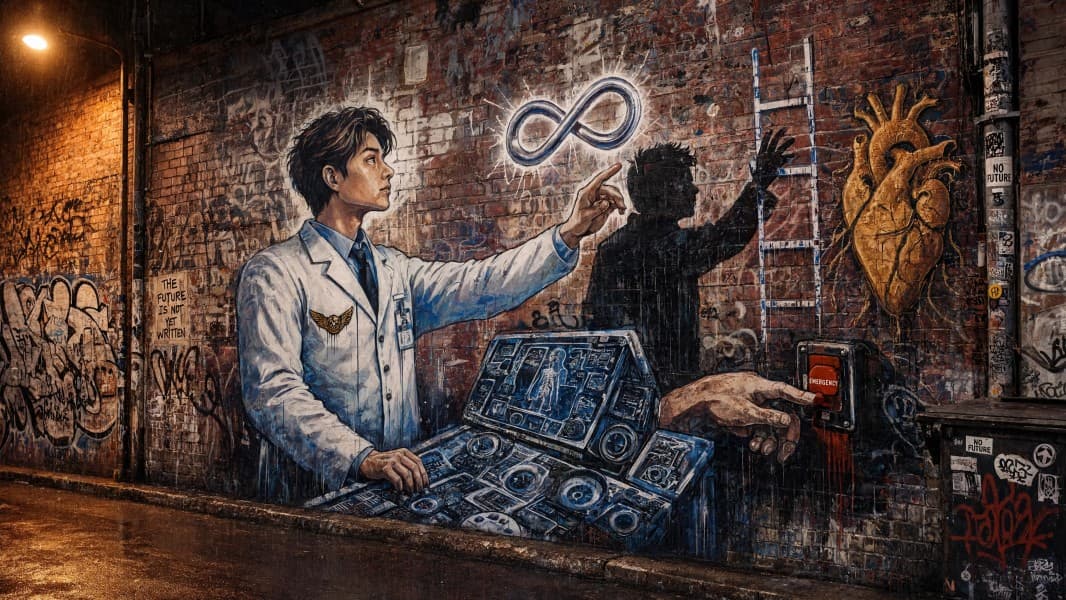
I use AI every day to research, write and build software. The screen fills faster than I can type, and the speed is intoxicating. Then I close the laptop and an awkward question remains: which parts of the work can I still do without it?
For me, a stubborn command or forgotten shortcut is inconvenient. For a doctor, the skill that quietly softened might be the one needed when the model is wrong, unavailable or confidently incomplete.
That risk now has a name: never-skilling. Deskilling is losing something you once knew. Never-skilling is reaching apparent competence without building the judgement underneath it, because AI was there first.
The danger isn't that tomorrow's doctors will know less. It's that they may perform well enough with AI that nobody notices what they never learned until the AI fails.
Three ways a skill can disappear
The distinction matters because three different failures are being bundled together.
An experienced clinician can become deskilled when a tool repeatedly performs a task on their behalf. A trainee can become mis-skilled by absorbing a plausible AI error as fact. Or that trainee can become never-skilled, able to produce the right answer with assistance but unable to reconstruct the reasoning alone.
The evidence is strongest for the first problem and still developing for the third. A Polish study followed gastroenterologists after an AI tool was introduced for colonoscopies. When they later worked without it, their adenoma-detection rate had fallen from 28.4% to 22.4%. It was an observational study across four centres, so it doesn’t prove that AI caused the drop. It does show that the concern is no longer purely philosophical.
Mis-skilling is becoming measurable too, mostly through AI scribes. More than 40% of Australian doctors now let an AI draft their consultation notes, and recent studies suggest roughly one in five of those notes contains an error serious enough to affect a diagnosis. Automation bias makes such errors hard to catch, because people are poor at spotting a machine’s mistakes under time pressure. Ontario’s auditor general reported inaccuracies in testing of the province’s approved scribes, and 11 of the 20 vendors had submitted no third-party audit at all. A wrong note that reads smoothly sits in the record and teaches the next reader.
The broader clinical-reasoning claim needs more humility. A recent evidence review found that most studies cover perceptual tasks such as polyps, ECGs and skin lesions. The 2026 Nature Medicine paper that introduced “never-skilling” is a precautionary framework, not proof that a generation of doctors has already lost its diagnostic judgement. The vocabulary is spreading fast all the same: a commentary published at the end of July in AI in Precision Oncology warns that oncology trainees may “reach answers before developing the reasoning framework required to evaluate, challenge, and contextualize them”.
Still, waiting for definitive proof would be a peculiar safety strategy. More than 80% of American physicians now use AI at work, according to the AAMC's 28 July review. Nearly three-quarters of clinicians already name skill loss as a major concern. The worry is no longer confined to physicians: after a dozen nurses at a New York hospital lost their jobs in July to review software, union director Joe-Ann Fergus warned that “when the inevitable happens that the system goes down, then nobody’s going to know how to read the images”. Training is changing much faster than longitudinal evidence can arrive.
For students, the risk is false proficiency: good performance in an AI-rich setting without an internal model to fall back on. They can see it coming: “My concern about AI is not that it will replace doctors,” wrote one medical student last week. “It is that we may be tempted to use it before we have fully developed the ability to think independently.” For experienced doctors, the risk is complacency under time pressure. Medical schools face a sequencing problem. Hospitals face an operational one. Patients face the consequence if everyone assumes that a human “in the loop” still has the skill to challenge the machine.
Some skills should disappear
There is an inconvenient counterargument, and it is a good one. We have always outsourced skills to tools. I no longer navigate every journey from memory. Clinicians don't calculate every drug dose with pencil and paper. Few people want surgeons spending precious attention on tasks a machine can perform more reliably.
Robert Wachter puts the case bluntly in the AAMC piece: accepting today's healthcare because AI feels risky is not a neutral choice. Burnout, avoidable errors and unaffordable care are risks too.
The real question is therefore not whether AI causes deskilling. It is which skills we are willing to let fade.
Factual recall may matter less when reliable evidence sits one query away. The ability to form a differential before seeing the machine's answer matters more, because it creates the independent position from which a clinician can disagree. The same goes for recognising deterioration, noticing when the available data doesn't fit the patient in front of you, and taking responsibility when the recommendation feels wrong.
AI can raise the floor. A Danish endoscopy study found that experienced doctors improved their detection rate by more than 12% with assistance. Inexperienced doctors did not improve significantly. The tool amplified a pattern library that experts already possessed. It couldn't replace the years needed to build one.
Borrow the pilot's rulebook
Aviation has lived through this problem. Autopilot made flying safer and created the automation paradox: the more reliable the system became, the less practice pilots had for the rare moment when it failed.
The answer wasn't to remove autopilot. Pilots maintain manual skills through recurrent simulator tests. A new clinical-AI proposal based on aviation recommends the same discipline for medicine: benchmark unaided performance, protect an AI-free phase in early training, and run “surprise breaks” that test whether a team can work safely when the automation disappears.
Medicine is edging that way already. STAT reported this week that medical schools and health systems have begun restricting trainees’ access to AI scribes while the evidence matures. “The process of deliberately crafting the note forces us to use our brains to really wrestle with what’s happening,” Jaideep Talwalkar, associate dean at Yale School of Medicine, told STAT. “There’s an importance in doing that with great repetition.”
That gives health systems three concrete moves. Ask clinicians to reason first and consult AI second during training. Test a small set of safety-critical skills without assistance every six months. Decide explicitly which skills may be outsourced and which must remain ready at 3am.
This is not nostalgia for medicine before AI. It is preparation for medicine with AI everywhere. Even the leaders of the Federation of State Medical Boards, writing on Monday about whether AI should be licensed to practise medicine, concluded that governance should keep “responsibility aligned to its level of autonomy and human oversight”. Human oversight is doing a lot of work in that sentence.
Before your next deployment, don't ask only whether the model performs better than the clinician. Switch it off for one scenario and ask whether the clinician still performs safely without the model. If nobody has measured that, the human oversight in your governance plan may be little more than a comforting label.
💥 May this inspire you to protect the skills that make disagreement possible.