Grow healthy habits at Thrivetopia
In 2019 I took my godchild to Bobbejaanland. I pay attention to what I eat and how much I move, and to me a theme park is an unhealthy environment. I went anyway.
The food on offer was French fries, hamburgers, sandwiches, waffles, pancakes, and candy in every single colour. I wanted a salad. I got one: green salad with one small slice of tomato, three slices of cucumber, and a few hardly noticeable carrot chips on top.
At the end of the day my watch said around 12,000 steps, and I told myself that the walking had made the trip somewhat less unhealthy.
That little rationalisation stayed with me, because it describes exactly how a theme park works. It gets you moving by accident and feeds you badly by design. Nobody planned the steps. Somebody very much planned the waffles.
The accidental workout is real
My 12,000 steps were one day on one watch. The first proper measurement I have found comes from Walt Disney World. In a study published in June 2026 in the American Journal of Lifestyle Medicine, Michael Fedewa and colleagues compared the daily step counts of 33 adults at home and during their Disney trip. Steps were lowest in the baseline week at home. On rest days during the trip they averaged 12,690. On days in a single park, 20,032. On days spent in more than one park, 25,309.
It is a small sample, mostly women, and the step counts were collected retrospectively, so I would not build a public health policy on it. But the authors' conclusion is the one I reached at the exit of Bobbejaanland: immersive, walkable places produce a lot of physical activity without anyone calling it exercise.
The food is not an accident
The other half of my rationalisation has been measured too. Maria Fusté Forné analysed the children's menus of the restaurants in Disney Village at Disneyland Paris with a validated instrument for kids' menus. Half of them were unhealthy. None of them were completely healthy.
So the places we take children for a day out already make people walk far more than on an ordinary day at home, and then hand them the menu above. The movement is a side effect. The food is the business model.
What if a park did both on purpose?
There are attractions about the human body. CORPUS in Oegstgeest, near Leiden, sends you on a guided route through the body as if you were a blood cell, followed by an interactive section about what happens inside you. It is educational and well made. But you are a passenger: your body is the subject of the ride, not the engine of it.
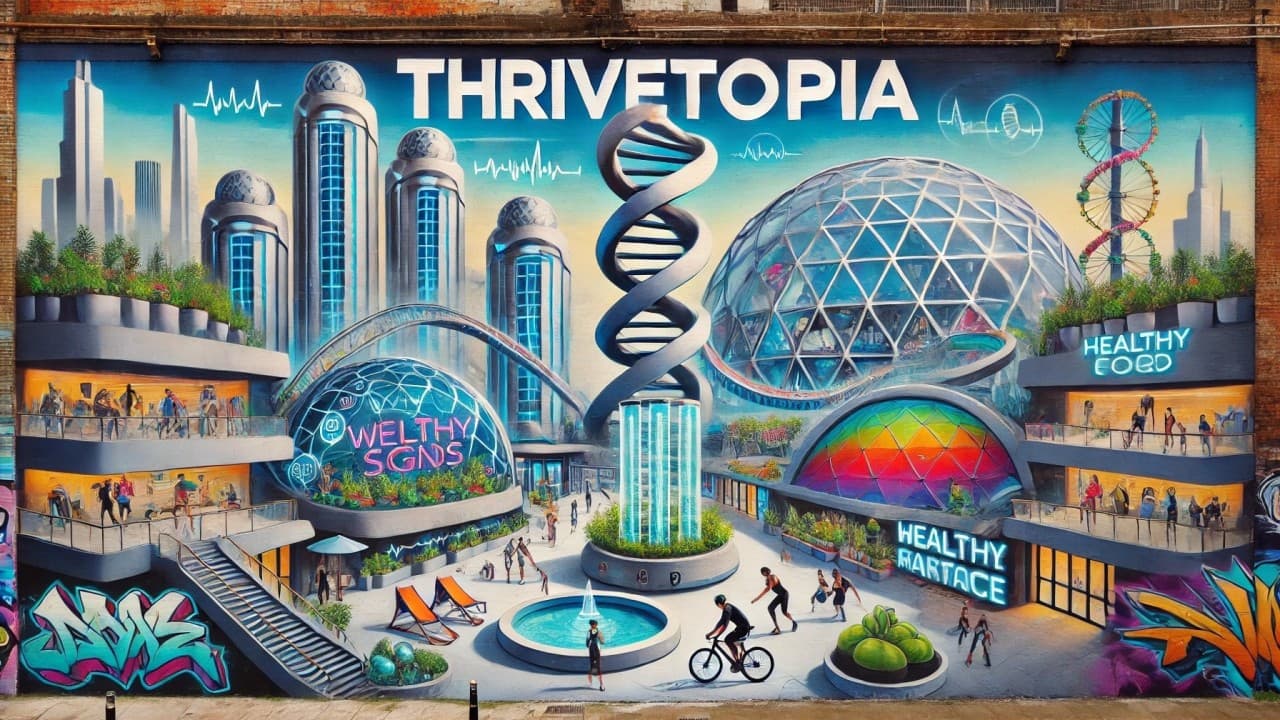
Thrivetopia is the opposite idea. A theme park where the visitor's own body powers the experience, and where the healthy choice is the default instead of three slices of cucumber.
Visitors don't just ride attractions; they power them. The Cardio Coaster challenges guests to power their ride through pedalling, demonstrating how consistent effort drives personal vitality. The Immune Labyrinth becomes an immersive journey through the human body, where participants collect nutrient tokens and unravel the mysteries of bodily defence. At Mindful Mountain, neural-feedback meditation chambers transform stress management into a breathtaking experience, with biofeedback sensors revealing the impact of mindfulness.
Nutrition Quest brings culinary innovation to life, with chefs demonstrating how healthy eating can be both delicious and accessible, and every food stand in the park follows the same rule: the healthy option is the default, and it is a real meal. The Muscle Quest Safari turns exercise into an animatronic adventure, where guests activate mechanical creatures through physical challenges. Each attraction is carefully designed to make health education both entertaining and memorable.
Beyond mere entertainment, Thrivetopia represents a living laboratory of wellness innovation. Corporate wellness programmes book entire park sections, medical device companies premiere cutting-edge technologies, and schools transform field trips into transformative learning experiences. The park proves that health education can be as thrilling as any theme park ride, serving as a global platform where entertainment and innovation intersect.
The steps are already there; existing parks prove that. The open question is whether anyone is willing to design the other half of the day with the same care that went into the waffles.