Nobody had ever said no
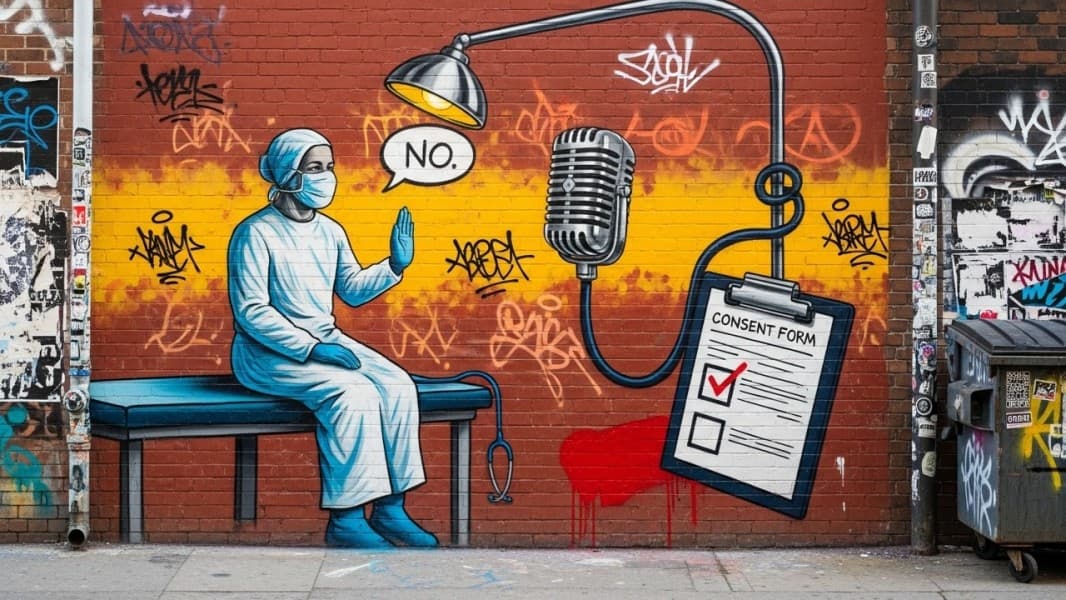
Ask where generative AI is really delivering in healthcare and you'll get the same answer you got two years ago: ambient scribes. They save time and cut admin while fitting neatly into the clinical workflow. Still the number one application, and deservedly so.
What the efficiency story keeps forgetting: the patient in the room can say no.
"My family doc informed me that 'we're using AI Scribe'. I said 'no'. He stopped in his tracks: nobody had ever said that to him before." That patient's account crossed my feed earlier this month, and the doctor's surprise is the detail worth sitting with. Somewhere between the pilot and the rollout, a question quietly became an announcement.
And the rollout is moving. Among UK GPs, 40% already use an ambient scribe, in 60% of their consultations on average. NHS England's Midlands region just procured the technology for all 1,239 of its GP practices and over 70,000 clinicians. The NHS 10-Year Health Plan instructs services to deploy "at pace".
Last week, Healthwatch England published what patients make of that pace. YouGov polled 4,039 adults: 81% want health professionals to ask before an AI scribe listens, while 89% of those who saw a clinician in the past year don't know whether one already had. Nearly everyone wants to be asked; almost nobody knows whether it happened.
We spent thirty years building patient rights around consent to treatment. Consent to the infrastructure of treatment was never designed, and that infrastructure is now listening.
The cost of skipping the ask surfaces exactly where medicine is most human. Comfort with a listening scribe drops from 48% during a routine check to 28% for mental health and 23% for domestic abuse. One patient told Healthwatch: "I certainly would not have shared some of what I did with the GP if I had known." Another discovered "completely by chance", days later, that the surgery had microphones in the consulting rooms. A patient who edits themselves in the consulting room walks out with a different diagnosis.
American courts are now testing the darkest version. In Washington v. Sutter Health, filed in April in federal court in California, patients allege Sutter Health and MemorialCare deployed an ambient scribe to record their consultations without informed consent, under a state wiretap statute that sets damages at $5,000 per recorded conversation. In an earlier class action, the EHR allegedly auto-generated boilerplate stating patients had been "advised of" and "consented to" the recording, when no such conversation took place. The checkbox said yes; nobody had asked. A psychiatrist on KevinMD dissected that artefact: "The box is checked. The exposure is assigned. The patient's actual understanding was never resourced."
Legislators are moving faster than professional norms. Rhode Island passed the first state law aimed squarely at ambient scribes: disclose the recording, give patients the right to decline. Texas has required plain-language AI disclosure since January.
Here's the finding that should reassure every worried medical director: asking works. In the GOSH-led trial across nine London NHS services, clinicians sought consent and 92% of patients said yes, while direct patient interaction time rose 23.5% and appointments got shorter. A new survey of 1,003 UK GPs in BMJ Health & Care Informatics found the same pattern in general practice: among GPs who ask, 89% report that one patient in ten or fewer declines. It also found that 37% of scribe-using GPs don't routinely ask at all. The ask cost seconds and bought trust.
So run the one benchmark that matters before your next rollout meeting: a patient says no. If the visit simply continues with a keyboard, you have consent. If the no produces friction, a flustered clinician, or quietly worse care, what you collected was surrender, and patients can tell the difference. Script the ask. Train it. Resource the no. The microphone comes last.
💥 May this inspire you to make the ask a real question.